Jim Crow Museum
1010 Campus Drive
Big Rapids, MI 49307
[email protected]
(231) 591-5873

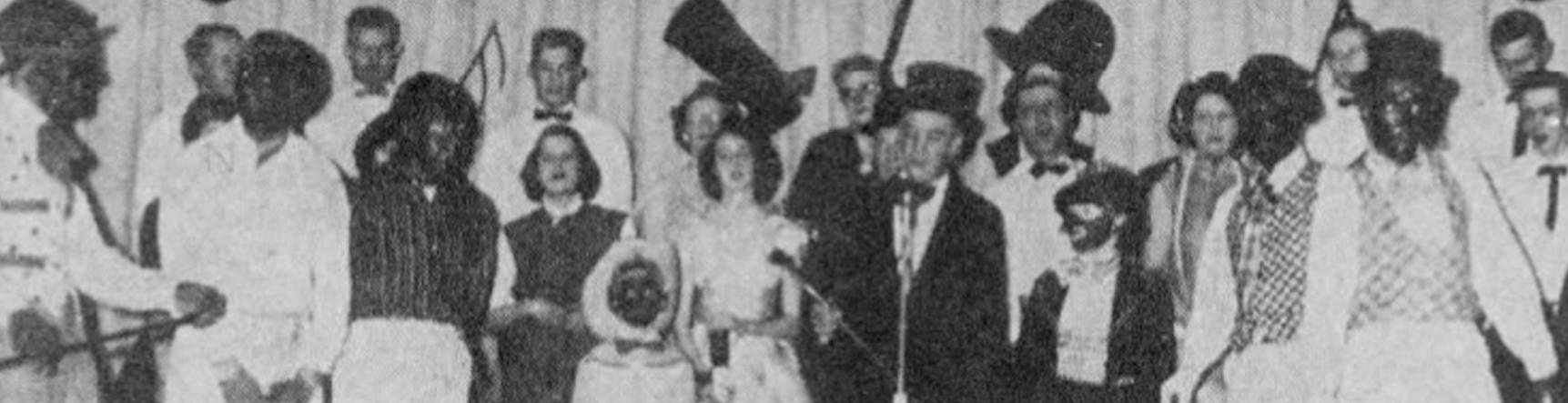
Q: Was the last professional minstrel show held in Vermont in the 1990s?
Susan H.
Burlington, VT
A: If you’re looking for one of the last clearly documented blackface minstrel shows in the United States, you eventually end up in an unexpected place: Tunbridge, Vermont, in 1991. By then, minstrelsy as a professional entertainment form had been gone for decades. Broadway’s last minstrel show closed in 1909, and touring companies faded out soon after. Yet in certain rural pockets of America, the tradition survived quietly in community halls and local fundraisers well into the late twentieth century. Tunbridge was one of those pockets.
According to historical and educational sources, the 1991 Tunbridge minstrel show was part of a long-running annual event organized by the local Civic Club. For nearly forty years, townspeople gathered in the Tunbridge Town Hall for a performance styled after 19th-century minstrelsy, complete with the semicircular staging, comic skits, and musical numbers that had defined the genre. Importantly (and controversially), many participants continued to use blackface makeup, a feature that by the 1990s was widely understood to be deeply offensive and tied to centuries of racist caricatures and stereotypes.
What makes the Tunbridge case especially striking is that, for many in the community, the show appears to have been understood primarily as a local tradition, rather than as a performance rooted in racial caricature. Longtime residents interviewed about the shows have often described them as lighthearted, nostalgic, and familiar—simply, an annual fundraiser, a chance to see neighbors on stage, and a continuation of “the way we’ve always done it.” In that sense, the participants may have naively failed to recognize the racism embedded in the tradition, assuming that their intent, to entertain and raise money, somehow trumped the show’s racist connotations.
A chapter titled “The Last Minstrel Show?” in the academic collection Putting Popular Music in Its Place analyzes the 1991 performance and frames it precisely in this way. The authors argue that the show functioned less as a deliberate act of racial mockery than as a cultural time capsule: a performance preserved by habit rather than ideology. The locals may not have meant harm, and many likely did not fully understand the historical weight of what they were reenacting. Yet the show was nonetheless rooted in a tradition built on support for America’s racial hierarchy, a fact that becomes impossible to ignore when viewed against the national cultural context of the early 1990s.
Because minstrelsy declined unevenly—professional companies ended by 1910, while amateur and community performances continued sporadically into the 1950s and ’60s—it is difficult to name a single absolute “last minstrel show” in the United States. Yet the 1991 Tunbridge performance stands out because it is one of the last clearly documented public blackface minstrel shows anywhere in the country, and almost certainly the last in Vermont. Many educational and historical organizations now cite it as the state’s final example of the form.
What makes the 1991 Tunbridge show historically significant is not only its lateness but also what it illustrates: that cultural traditions do not always end neatly. Some linger on the margins, embedded in local custom, persisting almost by inertia. The show’s survival into the 1990s is a reminder of how the past can live on in unexpected ways, and how communities must eventually reconcile cherished traditions with the difficult histories they carry.
Cambridge, Vivien Goldman (ed.). Putting Popular Music in Its Place. Cambridge University Press, 2003.
Flow of History (Northern New England Curriculum Collaborative). “Minstrel Show Posters: A Background Lesson to Introduce Civil Rights.”
Conway, Cecelia. African Banjo Echoes in Appalachia: A Study of Folk Traditions. University of Tennessee Press, 1995.
Lott, Eric. Love and Theft: Blackface Minstrelsy and the American Working Class. Oxford University Press, 1993.
Mahar, William J. Behind the Burnt Cork Mask: Early Blackface Minstrelsy and Antebellum American Popular Culture. University of Illinois Press, 1999.
Toll, Robert C. Blacking Up: The Minstrel Show in Nineteenth-Century America. Oxford University Press, 1974.
Miller, Karl Hagstrom. Segregating Sound: Inventing Folk and Pop Music in the Age of Jim Crow. Duke University Press, 2010.