Jim Crow Museum
1010 Campus Drive
Big Rapids, MI 49307
[email protected]
(231) 591-5873

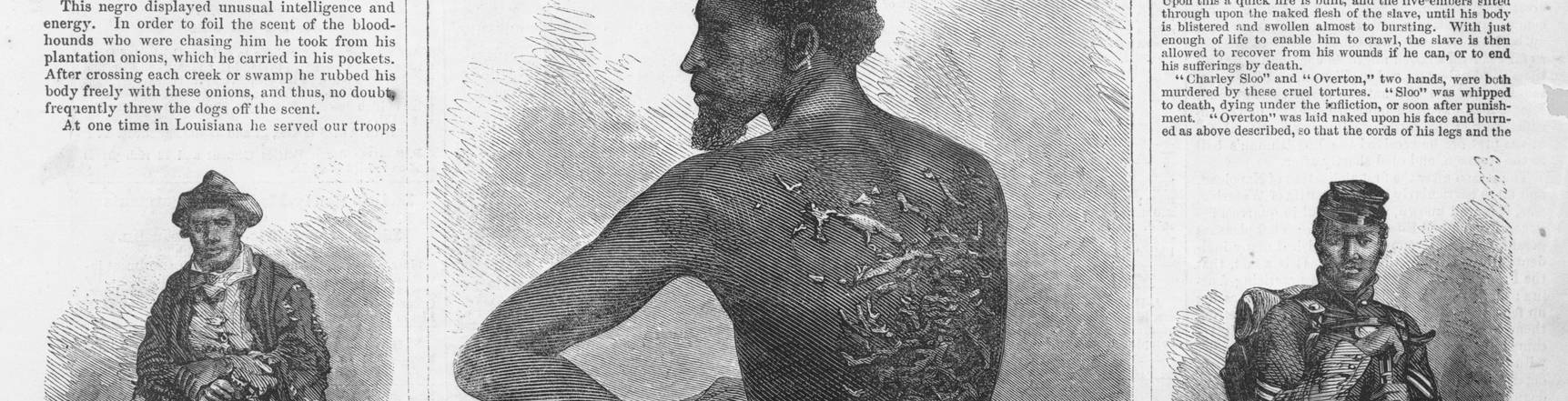
The story of Whipped Peter, also known in many records as Gordon, is one of the most powerful and revealing narratives to emerge from the American Civil War. His life wasn’t unusual in the sense that countless enslaved people endured violence, but what makes his story stand out is the way it was documented. His scarred back, photographed in 1863, became some of the most widely circulated visual evidence of the brutality of slavery.
Peter was enslaved in Louisiana, and like many enslaved men, he lived under relentless surveillance and physical punishment. At some point before 1863, he was whipped so severely that the wounds on his back formed thick, raised scars: keloids that told a story no words could fully capture. When you look at that photograph today, the first thing you understand is that this wasn’t simply “punishment”—it was torture.
In March of 1863, Peter decided to flee. His escape was dangerous and required an almost instinctive knowledge of how enslavers hunted people. One detail that appears in contemporary accounts is that he rubbed his body with onions to throw off the scent for tracking dogs: a technique some escapees used. After days of traveling through swamps and woods, he finally reached Union Army lines near Baton Rouge.
Once he was safely behind Union lines, doctors there examined him, and that’s when the infamous photograph of his back was taken. The image was shocking. Newspapers, abolitionist groups, and antislavery advocates used it to show the northern public exactly what slavery looked like when you stripped away all the euphemisms. It became a kind of visual testimony—undeniable and unforgettable.
Peter didn’t simply escape to safety; he continued fighting for freedom. He enlisted in the Union Army, joining one of the Black regiments that formed after the Emancipation Proclamation, and helped push the war toward a more explicit commitment to ending slavery.
His later life is harder to trace. Like so many formerly enslaved people, the historical record loses track of him as the war progressed. But the image of his scarred back and the story that accompanies it remain incredibly important. It reminds us that slavery was not an abstract institution. It left lasting, literal marks on human bodies. It also shows how enslaved people, even under terrifying conditions, resisted and fought for their own freedom.
In many ways, the story of Whipped Peter is both an individual biography and a national document. It tells us what one man endured, and it also reveals what the country permitted and what it ultimately had to confront.
Dr. David Pilgrim
Jim Crow Museum
2026
Dunn, Morgan. “‘Whipped Peter’ and the Photo That Exposed Slavery’s Horrors.” All That’s Interesting, 30 Sept. 2022.
“The Shocking Photo of ‘Whipped Peter’ That Made Slavery’s Brutality Impossible to Deny.” History.com.
“Gordon, aka ‘Whipped Peter’: His Life and Daring Escape to Freedom.” World History Edu.
“Peter (Enslaved Man).” Wikipedia.
Krauthamer, Barbara. Black Slaves, Indian Masters: Slavery, Emancipation, and Citizenship in the Native American South. University of North Carolina Press, 2013.
Smith, John David. Lincoln and the U.S. Colored Troops. University of North Carolina Press, 2013.