Jim Crow Museum
1010 Campus Drive
Big Rapids, MI 49307
[email protected]
(231) 591-5873

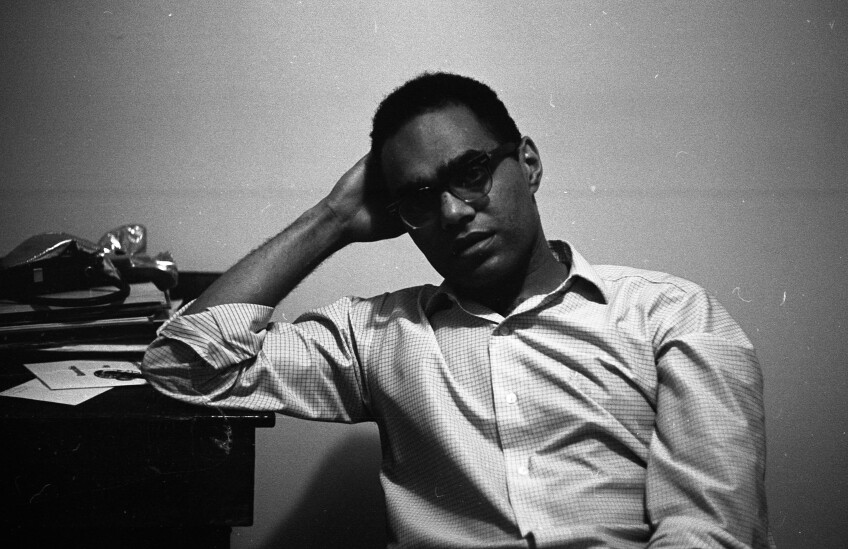
Bob Moses is often described as one of the quiet architects of the Civil Rights Movement. He avoided the spotlight yet shaped some of the era’s most important strategies. His influence stretched from the poverty-lined roads of Mississippi in the early 1960s to classrooms and community centers across the nation decades later. What ties these chapters of his life together is a simple but powerful belief: real change begins when poor people gain the tools to shape their own futures.
Moses joined the Student Nonviolent Coordinating Committee (SNCC) at a time when the movement was shifting toward deeper community engagement. Instead of mass rallies and charismatic leadership, SNCC emphasized knocking on doors, listening, and building trust. Moses took these approaches to heart.
His work in Mississippi made him a central figure in some of the most dangerous and transformative organizing of the era. He helped lead voter-registration campaigns in places where Black citizens were routinely threatened and brutalized for trying to register. Moses himself was beaten and arrested.
He helped design Freedom Summer in 1964, a large-scale effort that brought volunteers into Mississippi to expand voter education, build Freedom Schools, and directly confront the state’s all-white Democratic delegation. Although the Mississippi Freedom Democratic Party was not seated at the Democratic National Convention, its challenge exposed the depth of racial injustice and sparked a national debate over political representation that ultimately helped push the movement and federal policy forward.
After working abroad in the 1970s, Moses returned to the U.S. and confronted a different kind of inequality. He noticed his daughter struggling with algebra and realized how many young people, especially in under-resourced schools, were being shut out of higher-level math. To Moses, this wasn’t simply a classroom problem; it was a civil rights issue.
In 1982, he founded the Algebra Project, arguing that math literacy had become a gateway to economic and civic participation in a technologically driven society. Without access to algebra, students could not advance to the courses that lead to college readiness or STEM careers. The stakes were as high, he believed, as voting rights had been in the 1960s.
The Algebra Project used hands-on experiences, community partnerships, and youth leadership, principles Moses had honed during his SNCC years. Students might begin with something like a neighborhood bus ride, then learn to translate that real-world situation into mathematical terms. The project also launched the Young People’s Project, where students became math literacy workers who tutored and organized younger peers. In this way, Moses once again centered youth and local communities as the engines of democratic change.
Although Moses’s civil-rights work and his educational activism occurred decades apart, the connection is unmistakable. Whether teaching sharecroppers about voting or helping middle-schoolers understand algebra, Moses believed that empowerment must start at the community level. His legacy invites us to rethink what civil rights mean in different eras, and to recognize that full citizenship depends not only on political rights, but also on meaningful access to education.
Dr. David Pilgrim
Jim Crow Museum
2026
Carson, Clayborne. In Struggle: SNCC and the Black Awakening of the 1960s. Harvard University Press, 1981.
Cobb, Charles E. This Nonviolent Stuff’ll Get You Killed: How Guns Made the Civil Rights Movement Possible. Basic Books, 2014.
Moses, Robert P., and Charles E. Cobb Jr. Radical Equations: Civil Rights from Mississippi to the Algebra Project. Beacon Press, 2001.
Payne, Charles. I’ve Got the Light of Freedom: The Organizing Tradition and the Mississippi Freedom Struggle. University of California Press, 1995.
Ransby, Barbara. Ella Baker and the Black Freedom Movement: A Radical Democratic Vision. University of North Carolina Press, 2003.