Jim Crow Museum
1010 Campus Drive
Big Rapids, MI 49307
[email protected]
(231) 591-5873

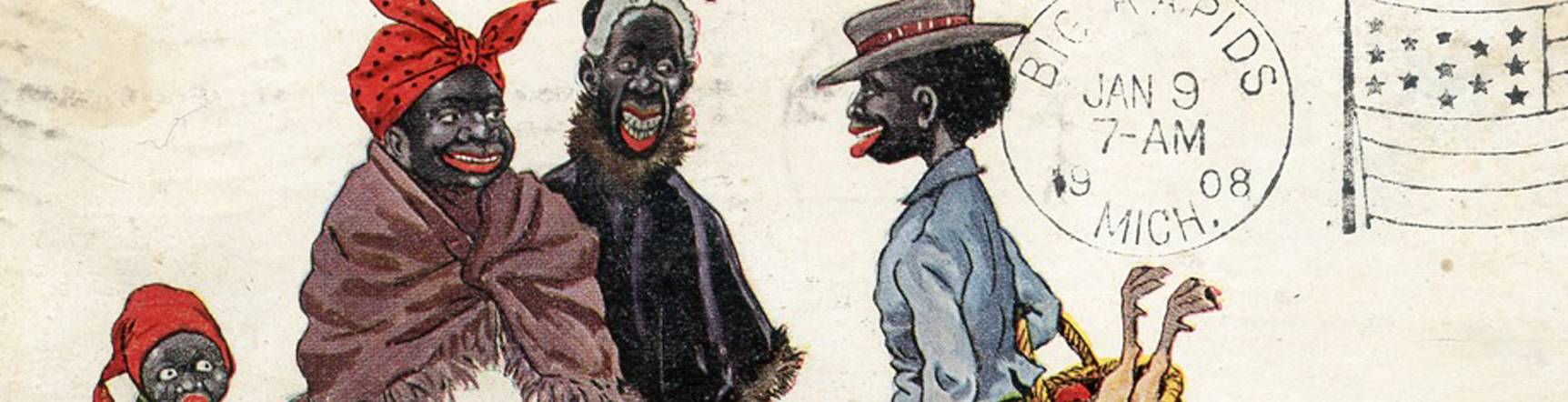
Q:Can you give a brief history of racist postcards?
Robert G.
Bakersfield, Ca.
A: If you browse through postcard albums from the early 20th century, you’ll likely to encounter postcards steeped in racism, colonial imagination, and dehumanizing caricatures. These small, inexpensive cards once functioned as a mass medium, quietly carrying some of the era’s most destructive caricatures and stereotypes straight into people’s homes.
Although postcards may seem like harmless travel keepsakes, their “golden age,” roughly 1900 to the 1940s, tells a different story. Publishers quickly realized that images intended to shock, exoticize, or amuse were profitable. Because postcards were cheap, easy to send, and socially acceptable, racist imagery spread widely and became woven into everyday life.
In the United States, this often took the form of postcards featuring grotesque caricatures of African Americans. Many depicted Black people as foolish or incompetent under the guise of humor. Much of this imagery drew directly from minstrel show traditions. Even more horrifying were postcards showing real lynchings—photographs of racial terror sold as souvenirs at mob killings. These cards were not just keepsakes of violence; they were instruments designed to broadcast dominance and intimidation.
European colonial powers produced their own version of racist postcards. Photographers working in colonized regions across Africa, Asia, the Middle East, and the Pacific staged scenes to portray Indigenous people as “primitive,” “exotic,” or frozen in time. Clothing was altered, props were added, and environments were manipulated to create images that satisfied European fantasies. These postcards were far more than novelty items. They were part of a broader ideological system that normalized and justified racial hierarchies and white domination.
Many racial and ethnic groups were targeted. Jewish communities were depicted using anti-Semitic stereotypes involving appearance or greed. Romani families were shown as vagrants or criminals. Asian and South Asian men and women were reduced to servants, laborers, or exotic curiosities. Indigenous peoples worldwide were represented as members of a savage race. Each image, however subtle, contributed to a larger narrative about who held power and who should not.
Today, most of these postcards survive in archives, museums, and scholarly collections. Because the imagery is harmful, professionals handle these materials with care: adding content warnings, providing historical context, and restricting access to especially graphic images, such as lynching postcards. Many institutions now consult with the communities represented before making decisions about preservation or display.
One of the most significant institutions engaging in this work is the Jim Crow Museum at Ferris State University. The museum actively collects racist postcards (including harsh caricatures, colonial scenes, and lynching photographs) and displays them as teaching tools rather than entertainment. Instead of hiding these objects away, the museum places them in carefully curated contexts that reveal how they functioned within broader systems of oppression. Exhibits pair postcards with historical timelines, interpretive labels, oral histories, and scholarly analysis, helping visitors understand not only what these images depicted but why they were produced and how they shaped social attitudes. Importantly, the museum emphasizes critical engagement over spectacle: the goal is to confront racism honestly, to dismantle its logic, and to empower viewers to recognize harmful imagery when they encounter it in both historical and contemporary forms.
Scholars across disciplines, including African American studies, history, anthropology, and visual culture, have helped reveal how these postcards operated within broader systems of racial meaning. Researchers like Patricia A. Turner, Henry Louis Gates Jr., Anne McClintock, and Shawn Michelle Smith have shown that such imagery was deliberate, influential, and deeply entangled in the construction of race, identity, and hierarchy.
Studying these postcards today isn’t about reviving old stereotypes; it’s about understanding how ordinary objects can reinforce extraordinary harm. They remind us that racism was not only encoded in laws and institutions; it was printed on souvenirs, mailed to friends, and saved in scrapbooks. The survival of these postcards provides difficult but essential evidence of how prejudice spreads, how it becomes normalized, and why we must continually question the images that shape our culture.
Dr. David Pilgrim
Jim Crow Museum
2026
References
Alloula, Malek. The Colonial Harem. University of Minnesota Press, 1986.
Allen, James, and John Littlefield. Without Sanctuary: Lynching Photography in America. Twin Palms, 2000.
Apel, Dora. Imagery of Lynching: Black Men, White Women, and the Mob. Rutgers University Press, 2004.
Word in Black. “The Horrors of Lynching Photographs and Postcards.” January 2022.
Gilroy, Paul. The Black Atlantic: Modernity and Double Consciousness. Harvard University Press, 1993.
Hoh, Anchi, and Fentahun Tiruneh, eds. “The Africana Historic Postcard Collection.” African & Middle Eastern Division, Library of Congress, 2023.
McClintock, Anne. Imperial Leather: Race, Gender and Sexuality in the Colonial Contest. Routledge, 1995.
Mellinger, Wayne. “Postcards from the Edge of the Color Line: Images of African Americans in Popular Culture, 1893–1917.” Symbolic Interaction 15, no. 4 (1992): 413–433.
Salisbury University, Edward H. Nabb Research Center. “Racist Postcards.”Unmentionable: The Indiscreet Stories of Artifacts. Salisbury University Libraries.
Smith, Shawn Michelle. Photography on the Color Line. Duke University Press, 2004.