Jim Crow Museum
1010 Campus Drive
Big Rapids, MI 49307
[email protected]
(231) 591-5873

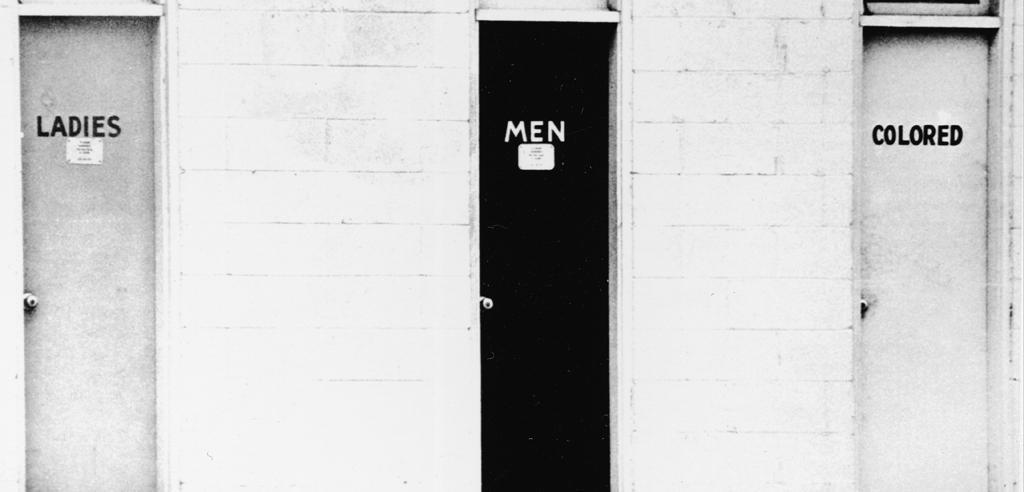
Q: What was the significance of segregated restrooms during the Jim Crow period?
~S. Brooks
Detroit, Michigan
A: Segregation in public restrooms offers a critical lens through which to understand the mechanisms and ideological foundations of the Jim Crow system. While the separation of entire facilities by race is well documented, less recognized are the administrative practices that sought to impose racial boundaries within shared sanitary spaces. These practices reveal the extent to which segregation functioned not only through statutory law but also through bureaucratic regulation, workplace policy, and everyday surveillance.
In numerous Southern workplaces—textile mills, municipal buildings, courthouses, and industrial plants—segregation was extended to objects as minor as toilet paper, soap, towels, and washbasins. Employee rulebooks and city maintenance codes frequently specified racially designated hygiene supplies, sometimes mounting two rolls of toilet paper within the same stall or offering separate bars of soap at the same sink.1 Violations could lead to formal discipline, demonstrating that these requirements held the force of policy even when not written into state-level law.2 These regulations were enforced by supervisors, building managers, or local authorities, illustrating the multilayered structure through which Jim Crow norms were maintained.
The rationale for such policies rested on the pseudoscientific racial hygiene theories pervasive in early twentieth-century discourse. Segregationists erroneously claimed that Black Americans posed unique sanitary dangers or carried distinct diseases, ideas that had no grounding in medical science but were nonetheless used to justify increasingly granular forms of racial control.3 As scholars have noted, anxieties about contamination and purity (common in racist thought) were mapped onto public health rhetoric to legitimize racial separation in intimate, bodily contexts.4 Such beliefs infused everyday administrative practices with the ideological weight of white supremacy, giving ordinary objects symbolic significance in the maintenance of the racial hierarchy.
The result was a form of segregation that permeated the rhythms of daily life. Requirements for racially designated toilet paper rolls or soap bars had no practical sanitary function; rather, they served as constant reenactments of supposed racial differences. In this sense, restroom segregation operated as a disciplinary technology, one that regulated bodies and reinforced white supremacy through routine interaction with public infrastructure. Historians consider these hygiene-based practices among the most telling expressions of Jim Crow’s reach precisely because they expose how deeply racial ideology was embedded in the material and administrative landscapes of the South.5 Restroom segregation, in both its physical and symbolic dimensions, thus offers a microcosm of the broader mechanisms through which racial inequality was perpetuated.
Dr. David Pilgrim
Jim Crow Museum
2025
Footnotes